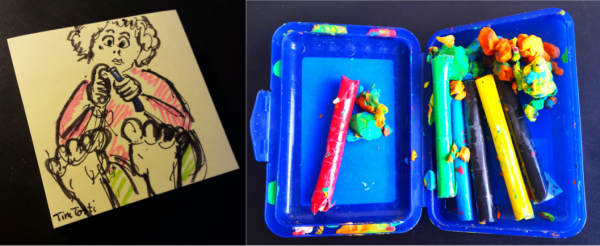
Children are a wonderful source of inspiration and they teach us so much on ourselves. Recently, on holiday, I bought modeling clay for my 2 years old daughter. I thought she would enjoy shaping and building things with it. I thought it was a good way for her to learn to make things by hand and get a feel of hand-made objects. Playing with her, I showed her the texture and prepared some balls and stuck them together. Very quickly, she wasn’t interested in what I was showing her and the only thing she was doing with the modeling clay was to scratch it with her little nails and make crumbs out of it that would fall on the table and the floor or stick to the clothes. That was a bit annoying! And now whenever she grabs the modeling clay, that’s what she does with it: crumbs…
At the same time, I had two feelings about it. First, I wanted to show here the « right » way to use modeling clay and I was suggesting her that making crumbs out of it was not what it was made for. But I was also witnessing my own narrow vision and my mental constructions of what should or shouldn’t be the use of modeling clay. After all, if she felt like making crumbs with it and had fun doing it, then she was creating her own use and understanding of this game; a use that I never thought of. And I want to encourage her to discover something without telling her « that’s how you should be using it ». That doesn’t mean I let her put crumbs all over the floor, on the furniture and on the clothes. But here is the point:
Usually products or services are created with a goal in mind and a definite way to achieve it. We usually expect the user to behave in a specific way, to « follow the plan », « follow the instructions » and use the solution for the purpose it was designed for. In fact it rarely happens like this. Human beings are experts to distort the purpose things were made for. And kids are even better at it – real experts.
Thinking we are smart enough to come up with solutions on our own and thinking we know how to handle a problem will very likely lead to some great disappointment when the product or the services reaches the real world.
That’s why designers feel the need to gain insight on how people use something or experience a situation. In their quest for understanding they often look for extreme users (Tim Brown talks about it in his book Change by Design) to broaden the vision on very unexpected ways to use something. That pinpoints at aspects of a question that would otherwise remain hidden but can be very valuable and bring the design to another level and really touch people.
This quality of « extreme user » can be found when persons use something in a weird way, but it is also the very identity of children. The youth spirit is also often used in design thinking to explain the mindset enabling creativity and innovation. It is a spontaneous mindset full of curiosity and facing anything with no preconceived notions, no schemes, no rules and constrains. Although it is not possible as an adult to fully switch back to a child mindset, it is very interesting to be able to use this as a tool at some points in a project. Putting yourself in the shoes of a child who is there to play, have fun and be naughty. And it can be good as well to have children around every now and then to test things you are working on, to test your solutions. It can bring a totally new point of view.
 Timothée Tosti
Laisser un commentaire